Saccharomyces boulardii: a specific and well-documented yeast
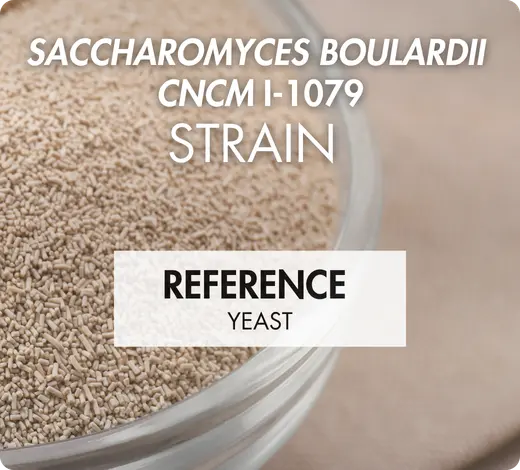
The strain Saccharomyces boulardii is subject to precise identification and registration within the Collection Nationale de Cultures de Microorganismes (CNCM), ensuring traceability, reproducibility and consistency of the strain used. This characterisation is an essential criterion in the selection of a yeast Saccharomyces boulardii intended for targeted use as a food supplement.
The yeast Saccharomyces boulardii belongs to the genus Saccharomyces, the best-known of which is the strain Saccharomyces cerevisiae, particularly in the fields of bakery and brewing, where its fermentative properties have been exploited for centuries. By contrast, this yeast has been little studied for its potential interactions with human physiology, outside these traditional uses.
The specific variant Saccharomyces cerevisiae var. boulardii was identified at the beginning of the 20th century. Its discovery is attributed to the French microbiologist Henri Boulard, who in 1920, while in Indochina, was interested in isolating new yeast strains suitable for fermentation processes. During his field observations, he noted that certain local populations consumed a traditional preparation based on tropical fruit skins, notably lychee and mangosteen. These fruit skins were used to prepare a tea, from which Henri Boulard succeeded in isolating a particular yeast strain, distinct from the strains of Saccharomyces cerevisiae known at the time. This strain was subsequently named Saccharomyces boulardii, in reference to its discoverer.
Since then, the yeast Saccharomyces boulardii has been the subject of a large number of scientific studies aimed at better understanding the biological characteristics and mechanisms of action of this yeast. This research has contributed to the recognition of Saccharomyces boulardii as a specific, distinct and widely documented variant within the species Saccharomyces cerevisiae. The strain Saccharomyces boulardii, precisely identified and registered, forms part of this scientific and historical continuity as a characterised yeast, now used in digestive food supplements according to an approach of precision probio-therapy.